How Does a Shared Power Bank Rental System Work? From QR Code to Return

A shared power bank rental system allows customers to rent a portable charger, use it on the go, and return it to a compatible rental station when they are finished.
Although the customer experience is simple, a complete rental system combines rental stations, power banks, software, payment systems, and a cloud-based backend to manage the entire rental process.
Understanding how these components work together is important for businesses planning to enter or expand in the shared power bank industry.
How Does a Shared Power Bank Rental System Work?
The basic rental process is:
Scan QR Code → Open Rental Page → Pay → Power Bank Released → Use → Return → Rental Completed
Each step is connected through the rental system.
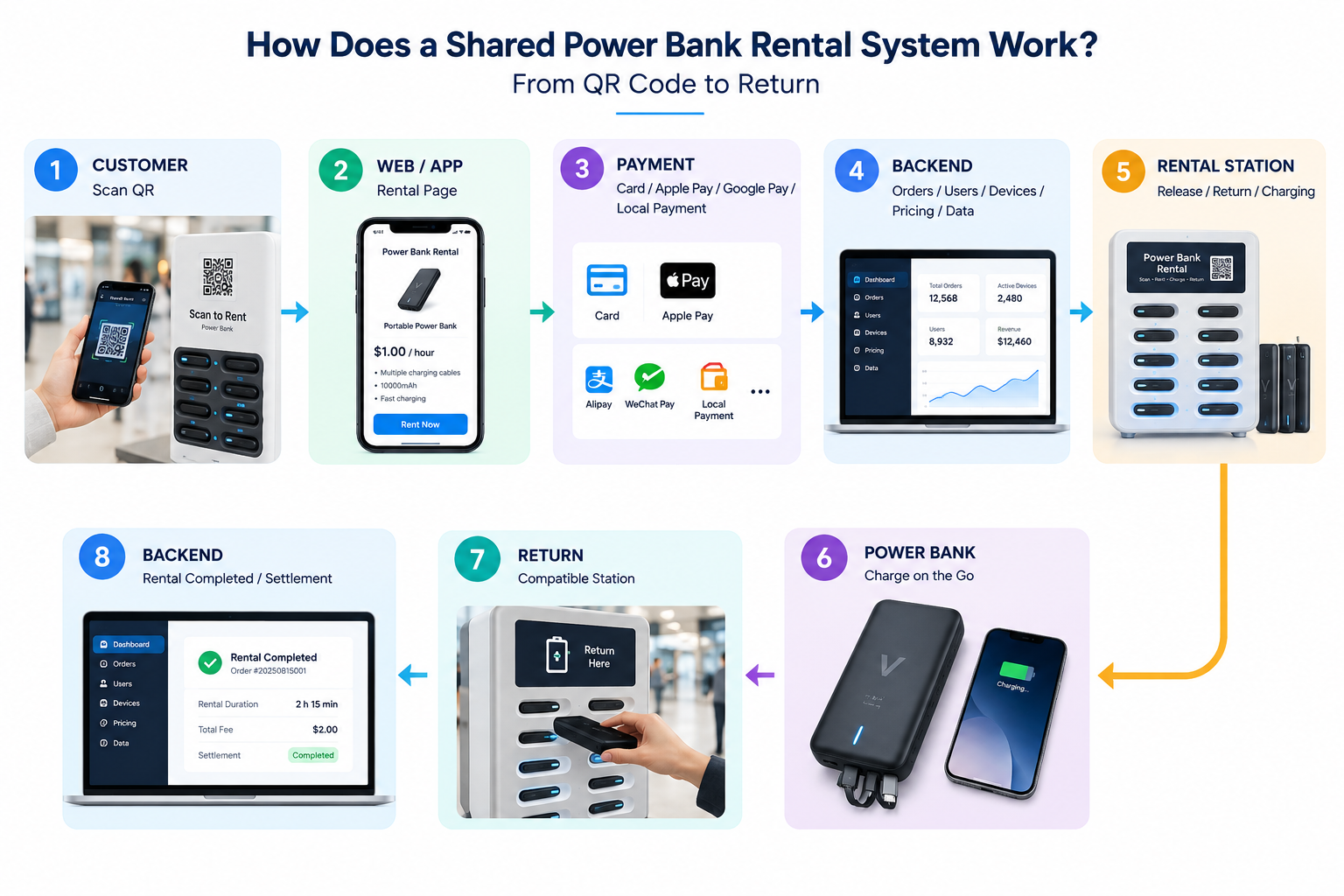
1. Scan the QR Code
The process starts when a customer scans the QR code displayed on a rental station.
Depending on the project, the QR code can open a mobile web page, H5 rental page, or app. A web-based rental system allows customers to start a rental directly from their smartphone without downloading an app.
2. Open the Rental Page
After scanning, the customer can view the available rental service, pricing, rental rules, and payment options.
The rental page can also be customized with the operator's own brand, logo, domain, and user interface.
3. Complete the Payment
The customer completes the required payment or authorization before the power bank is released.
Payment methods depend on the target market and can include bank cards, Apple Pay, Google Pay, and local payment methods.
For international projects, payment integration should be planned according to the local payment provider and business requirements.
4. The Station Releases the Power Bank
Once the payment is verified, the backend sends the rental command to the station.
The station automatically releases an available power bank, while the system records key rental information such as the station, power bank, order, and rental start time.
This allows the operator to track each rental throughout the process.
5. Use the Power Bank on the Go
The customer can take the power bank with them and charge their smartphone or other compatible devices wherever they need it.
Unlike fixed charging stations, shared power banks provide greater flexibility because customers do not need to stay at the original rental location.
6. Return the Power Bank
After use, the customer returns the power bank to a compatible rental station.
The station detects the returned power bank and sends the return information to the backend. In a multi-station network, customers can also return the power bank to another compatible station, depending on the operator's rental setup.
7. Rental Completed
Once the return is confirmed, the backend updates the rental order and calculates the applicable rental fee based on the configured pricing rules.
If a deposit or payment authorization is used, the corresponding settlement or refund can then be processed according to the payment setup.
The rental is completed, and the power bank becomes available for the next customer.
What Does the Backend Do?
The backend is the management center of a shared power bank rental system.
While customers only see the rental page, the backend manages the information and communication behind the service.
Depending on the solution, operators can manage:
Rental stations
Power banks
Users and orders
Pricing rules
Payment records
Device status
Rental data
Revenue reports
Remote device management
This allows operators to monitor and manage multiple rental stations from one platform.
How Do Hardware and Software Work Together?

A shared power bank rental system depends on communication between the customer interface, payment system, backend, and rental hardware.
The basic structure is:
Customer → Web/App → Payment → Backend → Rental Station → Power Bank → Return → Backend
The backend connects the different parts of the system. It can send commands to the station when a rental starts and receive device information when a power bank is returned.
For operators who already have their own technology platform, API or other integration methods can also be considered based on the project requirements.
What Should You Consider Before Launching?
Before starting a shared power bank rental business, operators should consider several key factors:
Target market: Where will the service operate?
Station capacity: How many slots are needed at each location?
Locations: Where will customers be most likely to rent?
Payment: Which payment methods are popular in the target market?
Software: Will you use supplier software, a white-label solution, or your own backend?
Rental rules: How will pricing, deposits, and non-return situations be handled?
Return network: Can customers return power banks to other compatible stations?
Starting with a small pilot can help operators test hardware, software, payment integration, locations, and customer demand before expanding the network.
Conclusion
A shared power bank rental system may look simple from the customer's perspective, but several technologies work together behind the scenes.
From QR code scanning and online payment to automatic release, device tracking, return detection, and rental settlement, each part contributes to the overall user experience and operational efficiency.
As a shared power bank manufacturer and technology solution provider, VSCHARGE (Shenzhen Welink Energy Co., Ltd.) provides rental stations, power banks, software solutions, white-label services, API integration, and OEM/ODM customization for different business models and markets.
Whether you are planning a small pilot or building a larger rental network, understanding how the system works is the first step toward choosing the right hardware, software, and operating model.


