How to Plan Your First Shared Power Bank Rental Pilot: Station Size, Power Bank Quantity, and Budget
Starting a shared power bank rental business does not always require a large initial investment. For new operators, a small pilot project can be a practical way to test local demand, evaluate rental performance, and understand daily operations before expanding to more locations.
However, choosing the right equipment is important. A station that is too small may not provide enough available power banks during busy periods, while purchasing too much equipment before validating demand can increase initial costs unnecessarily.
This guide explains how to plan your first shared power bank rental pilot, including station capacity, power bank quantity, screen options, software requirements, and expansion planning.
1. Start with Your Pilot Locations
Before choosing a charging station, identify where you plan to deploy it.
Shared power bank rental stations are commonly used in restaurants, bars, shopping malls, hotels, gyms, entertainment venues, and other locations where people spend time away from a power outlet.
Different locations have different usage patterns. For example, a restaurant may experience concentrated demand during meal times, while a hotel or entertainment venue may have rental demand spread across a longer period.
Before purchasing equipment, consider these questions:
How many locations will you test initially?
How many people visit each location on a typical day?
How long do customers usually stay?
Are there already competing charging services nearby?
Will the venue help promote the service, or will you need to attract users independently?
You do not need perfect demand forecasts before launching. The goal is to identify a few promising locations and establish a reasonable starting point for your pilot.
2. How Many Slots Should Your First Station Have?
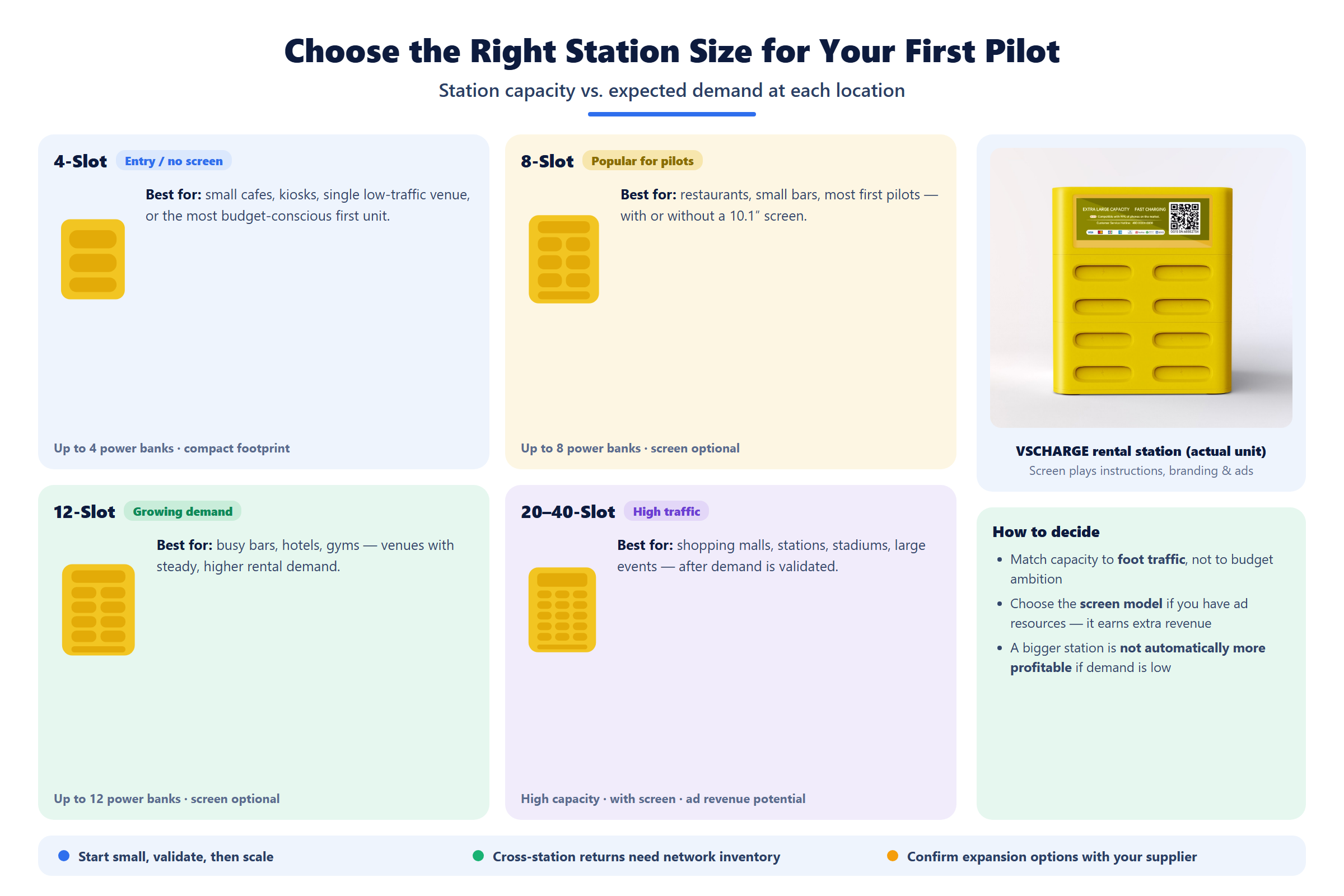
Station capacity determines how many power banks can be stored and made available for rental at one time. The appropriate size depends on expected demand, available installation space, and your initial budget.
8-slot stations: A practical starting point
An 8-slot station can be suitable for a small pilot, a single venue, or a business that wants to validate demand before investing in a larger network.
It is particularly worth considering when you are testing a new market, working with a small number of partner venues, or deploying your first few units.
12-slot stations: More capacity for growing demand
A 12-slot station provides additional storage capacity without moving immediately to a much larger unit.
It may be appropriate for busier restaurants, bars, hotels, or other venues where demand is expected to be higher. The final choice should still be based on the location and your operating plan.
Larger-capacity stations: Planning for expansion
Stations with 20 or more slots may be worth evaluating for high-traffic locations or established networks.
However, a larger station is not automatically more profitable. If demand is low, some power banks may remain unused. If demand is consistently high, insufficient capacity can limit the number of simultaneous rentals.
The best approach is to match station capacity to the expected demand at each location rather than choosing the largest model available.
3. How Many Power Banks Should You Order Per Station?
Station capacity and power bank quantity are related, but they are not always the same purchasing decision.
For example, an 8-slot station can hold up to eight compatible power banks at a time. An operator may initially purchase eight power banks per station, while a larger deployment may require additional inventory for replacement, maintenance, or future expansion.
For a first pilot, consider three factors:
Available rental capacity: How many power banks do you want ready for customers at each location?
Replacement inventory: Do you need spare units to replace damaged, lost, or temporarily unavailable power banks?
Network size: If customers can return power banks to other compatible stations, will your network have enough inventory to support movement between locations?
For a very small pilot, starting with one full set of power banks per station may be a straightforward approach. Additional inventory can be considered once actual rental and return patterns become clearer.
If you are planning a multi-location network, discuss your expected return arrangements and inventory strategy with your supplier before confirming the order.
4. Do You Need a Screen on Your Rental Station?
A screen is an optional configuration, and the right choice depends on your business model and marketing strategy.
Screenless stations
A screenless model may be suitable when your priority is to keep the initial equipment configuration simple. Customers can scan the station's QR code to access the rental process, subject to the software and payment setup.
This option may be worth considering for a budget-conscious pilot or locations where customers can easily see and understand the station.
Stations with a screen
A screen-equipped station can provide additional space for instructions, branding, promotional messages, or other supported content.
It may be useful in locations where customers need more guidance or where the operator wants to use the display for marketing.
When comparing the two configurations, consider not only the price difference but also the location, user experience, and potential promotional value. A screen should support a clear business purpose rather than being treated as a mandatory feature.
5. What Do You Need Besides the Hardware?
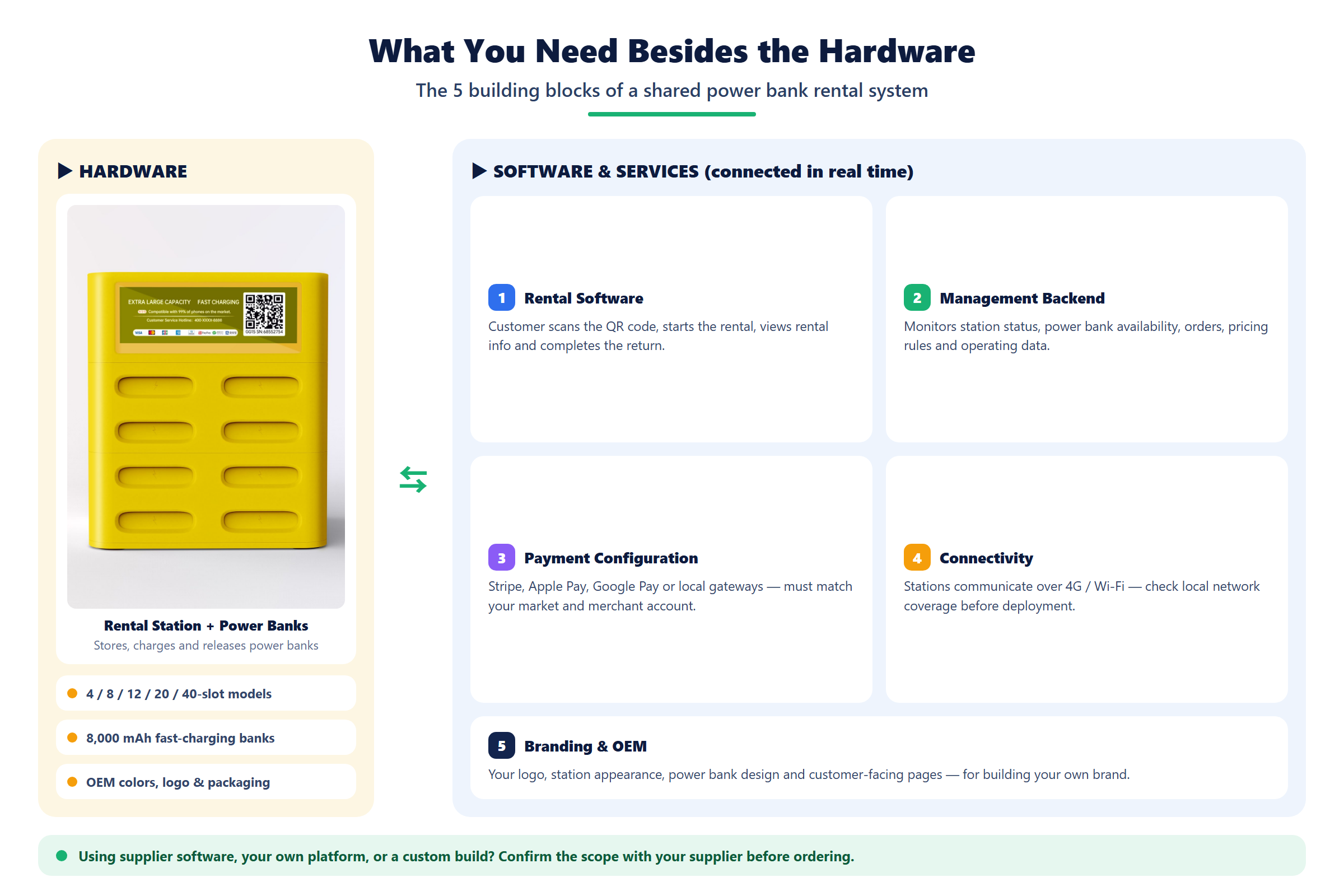
A shared power bank rental business requires more than charging stations and portable batteries. Before launching, make sure the major parts of the operating system are ready.
Rental software: Customers need a way to scan a QR code, start a rental, view relevant rental information, and complete the return process.
Management backend: Operators need tools to monitor station status, power bank availability, rental orders, pricing rules, and operating data.
Payment configuration: The payment method must work for your target market and be compatible with your software and merchant account arrangements.
Connectivity: Stations need a suitable network connection to communicate with the management system. Local coverage and supported network configurations should be checked before deployment.
Branding: If you plan to build your own brand, consider your logo, station appearance, power bank design, customer-facing pages, and other relevant brand elements.
The required setup depends on whether you use a supplier's software, integrate your own platform, or develop a customized solution. Confirm the scope before placing an order so that the hardware and software can work together as planned.
6. How Can You Control Your Initial Investment?
For a first pilot, it is useful to separate the project budget into several categories rather than looking only at the station price.
Typical cost categories include:
Charging stations and power banks
Software setup or customization
Payment integration, if additional development is required
Shipping, import duties, and applicable taxes
Installation and venue-related expenses
Spare inventory and ongoing operating costs
Not every project requires the same configuration. Some operators may begin with standard hardware and software, while others may need branded interfaces, a custom backend, or integration with an existing platform.
To compare supplier quotations fairly, check what is included in each offer. A lower hardware price does not necessarily mean a lower total project cost if essential software, integration, or shipping expenses are excluded.
For early-stage operators, a clearly defined pilot scope can help avoid unnecessary customization before the business model has been tested. 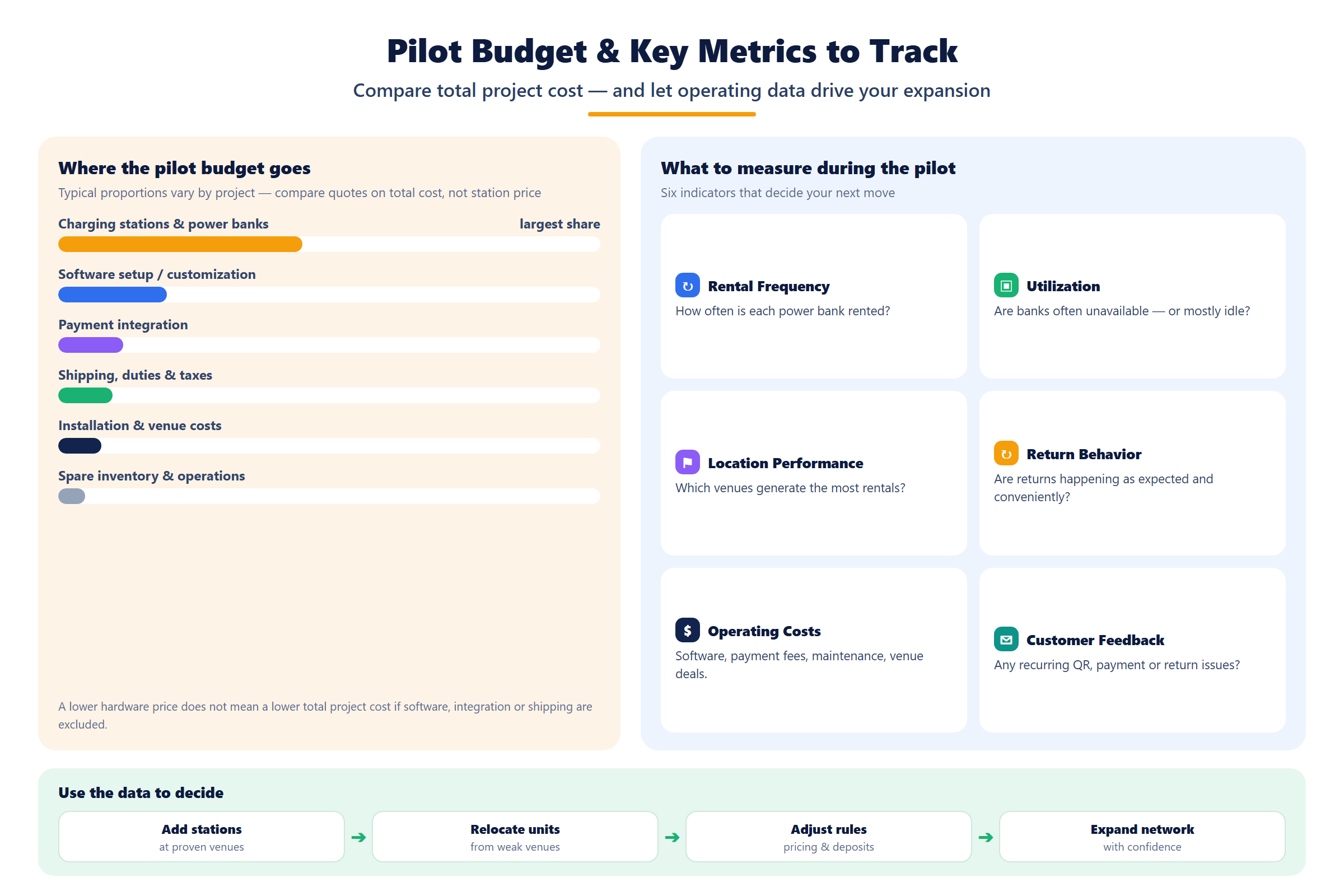
7. What Should You Measure During the Pilot?
The pilot should help you make decisions based on actual operating data, not just initial expectations.
Useful indicators include:
Rental frequency: How often is each power bank rented?
Utilization: Are power banks frequently unavailable, or do most remain idle?
Location performance: Which venues generate the most rental activity?
Return behavior: Are customers returning power banks as expected, and are the return arrangements convenient?
Operating costs: What are the actual costs of software, payment processing, maintenance, shipping, and venue partnerships?
Customer feedback: Do users understand the rental process? Are there recurring issues with QR-code access, payment, or returns?
Reviewing these indicators can help you decide whether to add stations, move equipment to better-performing venues, adjust rental rules, or expand your network.
A pilot is not only about generating initial revenue. It is also an opportunity to identify operational problems before they affect a larger deployment.
8. Plan for Expansion Before You Place Your First Order
Even if you begin with only a few stations, it is worth considering how the system will support future growth.
Ask your supplier whether additional compatible stations can be added to the same management system, how new locations will be configured, and whether the hardware supports your intended network design.
If you plan to use your own software, discuss the available API or communication protocol, supported commands, return-event information, and testing arrangements with the technical team.
You should also consider whether your initial configuration can support future branding changes, additional payment methods, or different station capacities. Confirm these capabilities individually rather than assuming every feature is included in a standard setup.
Planning ahead does not mean purchasing everything immediately. It means selecting a starting configuration that aligns with your long-term direction.
Conclusion: Start with a Pilot That Matches Your Business Plan
A successful shared power bank rental pilot begins with the right balance between location demand, station capacity, power bank inventory, software, and budget.
For new operators, a small deployment can provide valuable information about customer behavior and venue performance. Once the operating model has been validated, the business can make more informed decisions about adding equipment and expanding into new locations.
WELINK (VSCHARGE) provides shared power bank rental stations, compatible power banks, rental software, and hardware customization options for different business requirements.
If you are planning your first pilot, share your target country, expected number of locations, preferred station capacity, and software requirements with our team. We can help you evaluate a suitable configuration for your project.


