Shared Power Bank Distributor: 10 Proven Steps to Build a Successful Business
becoming a shared power bank distributor can be an interesting business opportunity for entrepreneurs who want to enter the growing mobile charging industry.
As smartphones become essential for communication, navigation, online shopping, digital payments, and entertainment, convenient charging services are becoming increasingly relevant in everyday environments.
Shared power bank rental stations offer a simple solution. Customers can scan a QR code, rent a portable charger, use it while moving around, and return it to a compatible station.
For distributors, this creates several potential business opportunities. You can supply equipment to local businesses, establish relationships with restaurants and shopping malls, develop your own rental network, or build a private-label charging brand.
However, becoming a successful distributor involves much more than purchasing charging stations from a manufacturer and reselling them.
You need to understand the local market, choose reliable products, establish a competitive business model, develop customer relationships, and provide ongoing technical support.
In this guide, we will explain how to build a shared power bank distribution business step by step.
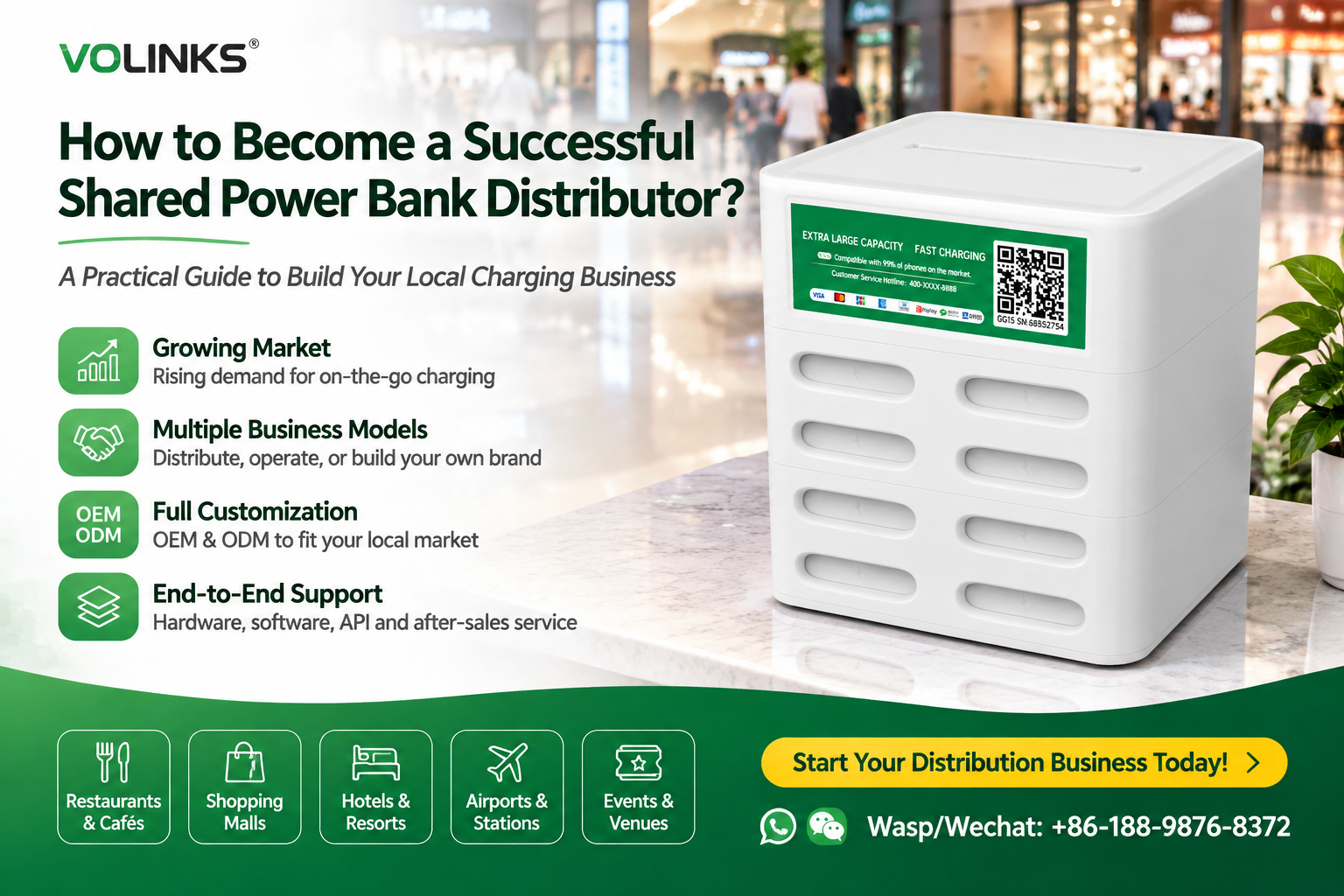
1. Understand the Shared Power Bank Distribution Business Model
Before entering the market, you should understand how the industry works and identify which business model suits your resources.
Generally, there are three possible approaches.
Equipment Distributor
You purchase shared power bank stations and portable chargers directly from a manufacturer and resell them to local businesses.
Your customers may include:
Shopping mall operators
Restaurant and café owners
Hotel groups
Entertainment venues
Local entrepreneurs
Companies developing charging rental networks
Your primary revenue comes from selling hardware and related products.
Local Rental Network Operator
Instead of only selling equipment, you purchase stations and operate your own rental network.
You establish venue partnerships, install stations, manage rental transactions, and earn revenue from customers using the charging service.
This model requires more operational involvement but gives you greater control over the customer experience and rental business.
Private-Label Business Provider
Another approach is to build your own brand and provide a complete rental solution.
You source customized stations, power banks, and software from manufacturers, then offer an integrated solution under your own brand.
This model may be attractive if you already have business relationships, technical resources, or an established customer base.
The first step is deciding whether you want to focus on hardware distribution, rental operations, or a combination of both.
2. Research Your Local Market Before Investing
Market research is one of the most important steps for any new shared power bank distributor.
A product that performs well in one country may not have the same commercial potential in another.
Start by understanding the charging habits and business environment in your target market.
Identify Potential Customer Groups
Consider businesses that have regular customer traffic and where people frequently use smartphones.
Some potential customer groups include:
Restaurants and cafés
Shopping malls and supermarkets
Hotels and resorts
Airports and transportation centers
Bars and nightclubs
Universities and campuses
Exhibition centers and event organizers
These locations may have different equipment requirements and purchasing budgets.
For example, a small restaurant may prefer a compact 4-slot or 8-slot charging station, while a shopping mall may require larger-capacity equipment.
Study Existing Competitors
Check whether shared power bank services already operate in your target country.
Research their station designs, rental prices, payment methods, locations, and customer experience.
Pay attention to the following questions:
Are customers familiar with renting portable chargers?
Which companies already provide similar services?
What rental prices are commonly used?
Are there enough convenient return locations?
What problems do existing operators experience?
Competition does not necessarily mean there is no opportunity. It can also indicate that customers understand the service and that a market already exists.
The key is identifying how your business can provide additional value.
3. Find a Reliable Shared Power Bank Manufacturer
Choosing the right manufacturer is one of the most important decisions for a distributor.
Your supplier directly influences product quality, purchasing costs, customization options, delivery arrangements, and technical support.
A low purchase price may look attractive initially, but unreliable hardware or insufficient technical assistance can create expensive problems later.
What Should You Look for in a Manufacturer?
Consider these factors when evaluating suppliers:
Manufacturing Capability
Choose a supplier with actual manufacturing capabilities rather than relying entirely on trading companies.
Ask about factory facilities, production capacity, quality inspection procedures, and experience with international customers.
Product Range
A reliable manufacturer should offer different station configurations to accommodate various deployment environments.
For example:
4-slot stations for small businesses.
8-slot stations for restaurants and cafés.
12–16-slot stations for medium-sized venues.
20–40-slot stations for shopping malls and high-traffic locations.
OEM and ODM Services
Brand customization is important if you want to develop your own identity.
Check whether the manufacturer supports customized logos, colors, station appearance, power banks, packaging, and software interfaces.
Technical Capabilities
Ask whether the hardware supports open APIs, independent server connections, remote monitoring, and payment integration.
These capabilities are especially important if you plan to develop your own software or operate an independent rental platform.
After-Sales Support
Confirm the warranty policy, spare parts availability, troubleshooting procedures, firmware updates, and technical communication channels.
A good manufacturer should support your business beyond the initial equipment purchase.
4. Choose the Right Products for Your Customers
Not every customer needs the same charging station.
A distributor should understand different product configurations and recommend equipment according to the customer's location, expected demand, and budget.
Select the Appropriate Station Capacity
Smaller stations are easier to place in locations with limited space.
Larger stations can accommodate more portable chargers and may be more appropriate for busy commercial environments.
A useful starting point is:
| Station Capacity | Potential Applications |
|---|---|
| 4 Slots | Small shops and cafés |
| 8 Slots | Restaurants and retail stores |
| 12 Slots | Hotels and medium-sized venues |
| 16–20 Slots | Shopping centers and entertainment locations |
| 32–40 Slots | High-traffic commercial locations |
These are general recommendations. Actual station selection should depend on expected rental demand.
Pay Attention to Power Bank Specifications
Power banks are another important part of the customer experience.
Consider battery capacity, charging speed, built-in cables, safety protection, and compatibility with different smartphones.
For example, 8,000mAh power banks with USB-C and Lightning charging options can provide a flexible solution for different users.
A distributor should understand these specifications well enough to explain the differences to potential customers.
5. Understand the Software Behind the Business
One common mistake made by new distributors is focusing entirely on hardware.
In reality, a shared power bank rental business requires software to manage customer rentals, payments, devices, and business operations.
A complete system may include several components.
Customer Rental Interface
Customers scan the QR code on a station and access a rental webpage or mobile application.
They can complete the required payment process and rent a power bank.
Operator Management Dashboard
The management platform allows operators to monitor:
Station connectivity
Available power banks
Rental and return records
Transaction information
Device status
Operating performance
Remote Device Management
Operators should be able to monitor equipment remotely and receive device status information.
Functions such as remote troubleshooting and OTA firmware updates can help reduce unnecessary on-site maintenance.
White-Label Software or Independent Development
There are two common approaches.
The first is to use a white-label software solution that can be customized with your own brand.
The second is to develop your own platform and connect it to the charging stations through APIs and communication protocols.
For distributors who want to build a long-term rental network, understanding software ownership, server hosting, maintenance costs, and payment integration is particularly important.
Always clarify whether software fees are one-time licensing or development costs, and whether server hosting and payment processing involve separate expenses.
6. Develop Your Own Brand Through OEM and ODM Customization
If you want to compete beyond simply offering low equipment prices, branding can help differentiate your business.
Instead of selling generic charging equipment, you can develop a recognizable local brand.
A professional manufacturer may support several customization options:
Station logo and exterior design
Customized station colors
Power bank branding
Customized QR code
Packaging design
Screen advertising content
Customer rental interface
Branded mobile applications
For example, a distributor targeting the European market may prefer a minimalist station design, while another targeting entertainment venues may choose more eye-catching colors.
The goal is to create a consistent brand experience across hardware, software, and customer interactions.
This can also make it easier to build long-term relationships with commercial customers.
7. Understand Local Payment Methods and Technical Requirements
Payment integration is essential to the rental experience.
Different countries have different payment preferences, regulations, and available payment providers.
Depending on the market, your rental system may need to support:
Visa and Mastercard
Apple Pay and Google Pay
Credit and debit cards
Local digital wallets
Regional payment gateways
Contactless POS terminals
For example, Stripe supports businesses in a range of countries and regions, but eligibility depends on the business location and account requirements.
You can check the official Stripe Global Availability page before planning your payment solution.
Distributors should also understand the difference between online payments and physical POS payments.
A station with compatible POS hardware may support contactless transactions, while another configuration may rely entirely on QR-based online payments.
In addition, investigate local requirements for electrical safety, wireless communication, lithium battery transportation, product labeling, and other applicable certifications.
Do not assume that one certification automatically covers every country.
8. Build Strong Local Sales Channels
Finding customers is often more challenging than purchasing equipment.
A successful shared power bank distributor needs a clear sales strategy.
Build Relationships with Commercial Venues
Start by approaching businesses that may benefit from providing portable charging services.
Instead of simply asking them to purchase equipment, explain how the service works and what value it could bring to their customers.
You can demonstrate the rental process, show the station design, and explain the available payment methods.
Work with Business Owners and Local Companies
Potential customers may include restaurant groups, hotel operators, shopping mall management companies, and technology businesses.
Building relationships with decision-makers can help you reach multiple locations through one commercial partnership.
Use Digital Marketing
Create a professional website and social media presence to introduce your products and services.
Useful marketing channels include:
Google Search
LinkedIn
Facebook
Instagram
Industry exhibitions
Local business directories
B2B marketplaces
Publish educational content explaining how shared power bank rental works, how businesses can deploy stations, and what customers need to operate their own networks.
A professional online presence can help establish credibility before the first sales meeting.
9. Calculate Your Costs and Profit Margins
A distributor should understand the complete cost structure before offering quotations to customers.
The total cost of a project may include:
| Cost Category | Details |
|---|---|
| Hardware | Charging stations and power banks |
| Logistics | International shipping and local delivery |
| Customs | Import duties and applicable taxes |
| Software | Licensing, development, or customization |
| Server | Hosting and infrastructure |
| Payment | Transaction processing fees |
| Marketing | Advertising and customer acquisition |
| After-Sales | Maintenance, spare parts, and support |
For equipment distribution, calculate your landed cost before deciding on the selling price.
For rental operations, additional factors include rental frequency, venue commissions, battery losses, maintenance, and payment fees.
A simple equipment distribution calculation is:
Gross Profit = Selling Price - Total Landed Cost
For rental operations, you should separately calculate revenue per station, monthly operating expenses, and the expected payback period.
Avoid promising customers guaranteed returns. A realistic business forecast should be based on actual location performance and local rental pricing.
10. Provide Reliable After-Sales Service
A successful distributor does not disappear after delivering the equipment.
Customers expect support when they encounter problems with their stations, power banks, software, or payment systems.
Your after-sales service may include:
Installation guidance
Basic troubleshooting
Software configuration
Device connectivity support
Spare parts replacement
Firmware updates
Customer operation training
If you plan to serve multiple cities or regions, establish a clear technical support process.
You should also maintain communication with your manufacturer to resolve technical issues efficiently.
Reliable support can improve customer satisfaction and create repeat business opportunities.
11. Start with a Pilot Project and Expand Gradually
If you are new to the shared power bank industry, avoid purchasing excessive inventory before validating your market.
A small pilot project can help you understand actual customer demand.
A practical approach is:
Step 1: Select a Target Market
Choose one city or commercial area where you can identify potential customers.
Step 2: Find Initial Business Partners
Approach several restaurants, shopping centers, hotels, or entertainment venues.
Step 3: Purchase Sample Equipment
Test the hardware, rental software, payment process, and station connectivity.
Step 4: Collect Operating Data
Monitor rental frequency, return rates, customer feedback, and equipment performance.
Step 5: Improve Your Business Model
Adjust equipment selection, rental prices, venue partnerships, and marketing strategies according to actual results.
Step 6: Expand Your Customer Network
Once you have a repeatable sales and operating process, gradually increase inventory and develop additional locations.
Starting with a manageable project allows you to identify problems before making larger investments.
12. Common Mistakes Every New Distributor Should Avoid
Even with a promising market, poor decisions can make a distribution business difficult to sustain.
Here are several mistakes worth avoiding.
Choosing a Manufacturer Based Only on Price
The cheapest supplier may not provide the product quality or technical support required for long-term operations.
Buying Too Much Inventory Too Early
Large purchases without confirmed customers can create unnecessary financial pressure.
Ignoring Software Compatibility
Hardware and software must work together. Confirm the rental process, communication protocol, payment integration, and server requirements before ordering.
Underestimating Local Compliance
Check applicable product, battery, electrical, wireless, and import requirements before commercial deployment.
Ignoring After-Sales Service
Without a support plan, even minor technical problems can damage your customer relationships.
Making Unrealistic Profit Promises
Rental performance depends on real customer demand, location quality, pricing, and operating costs.
A sustainable business should be built around realistic financial assumptions rather than exaggerated returns.
13. Work with the Right Manufacturing Partner
Becoming a successful shared power bank distributor requires more than finding a supplier that can offer competitive prices.
You need a manufacturing partner that understands hardware, software, customization, communication protocols, and international project requirements.
VOLINKS, the shared power bank manufacturing and solutions brand of Shenzhen Welink Energy Co., Ltd., provides products and solutions for businesses developing their own power bank rental networks.
Our capabilities include:
1. Shared Power Bank Hardware
Different station capacities and configurations are available for restaurants, hotels, shopping malls, entertainment venues, and other commercial locations.
2. OEM and ODM Customization
We support customized station appearance, logos, colors, power banks, QR codes, packaging, and other branding requirements.
3. White-Label Software Solutions
Depending on project requirements, solutions can include QR-based Web rental, branded mobile applications, and operator management dashboards.
4. Open API and Hardware Integration
For customers with their own development teams, we support communication protocols and integration with independent software platforms and payment systems.
5. Technical Support
Our team can assist with hardware testing, system integration, troubleshooting, and deployment preparation.
Whether you are planning to sell equipment locally, develop your own charging brand, or operate a rental network, choosing the right hardware and technical solution is an important first step.
Explore our Shared Power Bank Business Solutions and OEM/ODM Hardware Solutions to learn more.
Conclusion: Build a Sustainable Shared Power Bank Distribution Business
Becoming a successful shared power bank distributor is a process that requires market research, product knowledge, reliable manufacturing partners, effective sales channels, and long-term customer support.
The best approach is to start with a clear business model, understand your target customers, select suitable equipment, and validate demand through a pilot project.
As your business grows, you can expand your product range, strengthen your local partnerships, develop your own brand, and explore additional rental business opportunities.
Most importantly, do not focus only on selling charging stations.
Focus on providing a complete solution that helps your customers build and operate their own businesses.
Ready to Explore Your Shared Power Bank Project?
VOLINKS provides shared power bank stations, portable chargers, OEM/ODM customization, white-label software, and API integration solutions for international projects.
Visit our official website:
For product information, technical discussions, or factory quotations, contact us:
WhatsApp / WeChat: +86-188-9876-8372
VOLINKS – Your Manufacturing Partner for Shared Power Bank Solutions.


